
As parents, every milestone in a child’s life is celebrated—from their first smile and first words to their first day at school. However, when a child struggles with communication, attention, behaviour, learning, or social interaction, it is natural to wonder whether these are simply developmental variations or signs that additional support may be needed.
Seeking professional guidance early is not about placing a label on a child. It is about understanding how they learn, communicate, and experience the world. A timely Autism Assessment, ADHD Testing for Children, or Child Psychology Assessment can provide valuable insights into a child’s strengths and areas of need, allowing families to access evidence-based interventions that help children reach their fullest potential.
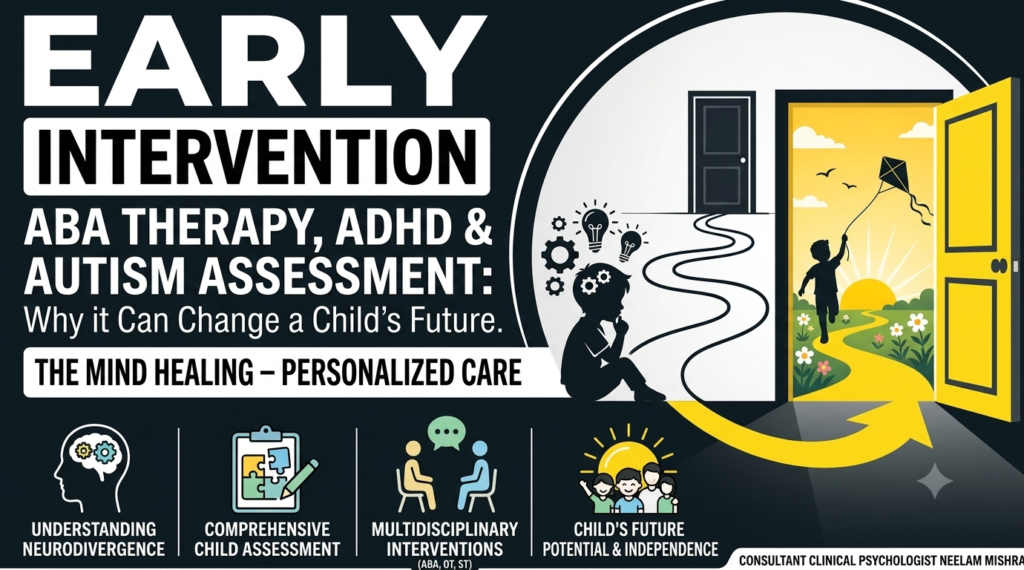
At The Mind Healing, Consultant Clinical Psychologist Neelam Mishra believes that every child deserves personalised care based on their unique developmental profile. Through comprehensive assessments and multidisciplinary interventions, children receive the support they need to thrive academically, socially, and emotionally.
Understanding Neurodivergence
Neurodivergence refers to the natural differences in the way the brain develops and functions. Conditions such as Autism Spectrum Disorder (ASD), Attention-Deficit/Hyperactivity Disorder (ADHD), Specific Learning Disorders, and other developmental conditions are all part of the neurodiversity spectrum.
Every neurodivergent child is different. Some children may struggle with attention and impulsivity, while others may experience challenges in communication, sensory processing, or social interaction. Many also possess remarkable strengths, including creativity, exceptional memory, visual thinking, or problem-solving abilities.
The goal of psychology is not to change who a child is. Instead, it is to understand their individual strengths, identify barriers to learning or communication, and provide evidence-based support that enables them to succeed.
Recognising the Early Signs
Parents often notice subtle changes long before anyone else.
Some common signs that may indicate the need for an assessment include:
- Limited or delayed speech
- Difficulty maintaining eye contact
- Reduced response to their name
- Repetitive behaviours or restricted interests
- Hyperactivity or constant movement
- Difficulty sitting through activities
- Poor concentration and impulsive behaviour
- Challenges in understanding instructions
- Difficulty making friends or interacting socially
- Sensory sensitivities to sounds, lights, textures, or touch
Experiencing one or two of these behaviours does not necessarily indicate Autism or ADHD. However, when these behaviours persist or interfere with everyday functioning, consulting a psychologist can help determine whether further evaluation is required.
Why Early Assessment Matters
One of the biggest misconceptions surrounding developmental disorders is that children will simply “grow out of” their challenges. While children continue to develop over time, delaying assessment often means delaying intervention during the years when the brain is most adaptable.
Early identification enables professionals to understand not only the child’s difficulties but also their learning style, strengths, interests, and developmental potential.
A comprehensive Child Psychology Assessment provides valuable information that helps parents, educators, and therapists work together to create personalised intervention plans.
Depending on the child’s presentation, psychologists may recommend:
- Autism Assessment
- Autism Screening Test
- ADHD Testing for Children
- Developmental Assessment
- Behavioural Evaluation
- Cognitive Assessment
- Emotional Assessment
- Learning Disability Assessment
- Special Education Assessment
Similarly, many adolescents and adults continue to struggle with attention, organisation, or impulsivity without ever having received a diagnosis. In such situations, an Adult ADHD Assessment can provide clarity, helping individuals understand long-standing challenges while accessing appropriate therapeutic support.
What Happens During an Autism or ADHD Assessment?
Parents often feel anxious before their child’s first assessment, imagining it to be a lengthy or intimidating process. In reality, psychological assessments are designed to be supportive, child-friendly, and comprehensive.
At The Mind Healing, assessments are conducted using internationally accepted psychological methods and standardised clinical tools. The process focuses on understanding the child as a whole rather than simply identifying symptoms.
A comprehensive assessment typically includes:
- Detailed parent interviews and developmental history
- Behavioural observations
- Standardised psychological assessments
- Attention and executive functioning evaluation
- Communication and language assessment
- Social interaction assessment
- Cognitive and intelligence testing where appropriate
- Emotional and adaptive functioning assessment
- Parent feedback and personalised intervention planning
When academic difficulties are also present, additional evaluations such as a Learning Disability Assessment, Dyslexia Assessment, Dysgraphia Assessment, Dyscalculia Assessment, SLD Assessment, or the NIMHANS SLD Battery may be recommended to understand the child’s educational needs and determine appropriate school accommodations.
More importantly, assessment is never the end of the journey—it is the beginning of one. Once a child’s strengths and challenges are clearly understood, the focus shifts towards intervention. One of the most effective evidence-based interventions for children with Autism and other developmental conditions is ABA Therapy (Applied Behaviour Analysis), which works alongside Behavioural Therapy, Occupational Therapy, and Speech Therapy to build lifelong skills and independence.
