
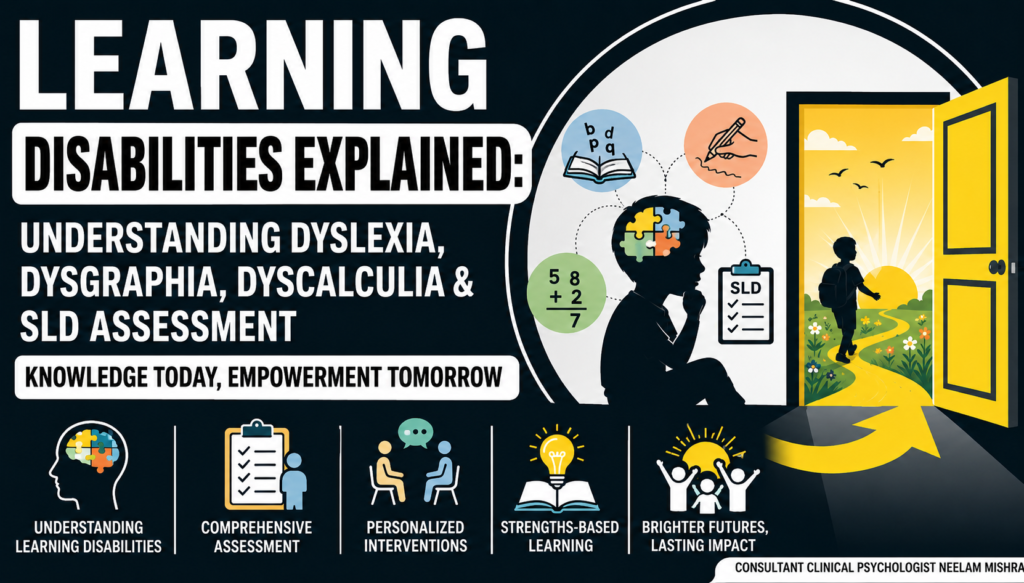

Every child learns differently. While some children quickly grasp reading, writing, or mathematics, others may struggle despite having average or above-average intelligence, supportive parents, and quality education. These persistent academic challenges are often misunderstood as laziness, lack of effort, or poor concentration. In reality, they may indicate the presence of a Specific Learning Disorder (SLD).
A learning disability is not a reflection of intelligence or potential. It is a neurodevelopmental condition that affects the way the brain receives, processes, stores, or expresses information. With timely identification, appropriate educational support, and evidence-based intervention, children with learning disabilities can perform successfully in school and beyond.
At The Mind Healing, Consultant Clinical Psychologist Neelam Mishra provides comprehensive Learning Disability Assessment, SLD Assessment, and psychological evaluations to help children understand their strengths while receiving the support they need to thrive academically and emotionally.
What is a Specific Learning Disorder (SLD)?
A Specific Learning Disorder (SLD) is a recognised neurodevelopmental condition that affects specific academic skills such as reading, writing, spelling, or mathematics. Children with SLD have normal intellectual abilities but experience persistent difficulty in one or more learning areas.
These challenges cannot be explained by poor teaching, lack of motivation, sensory impairments, or limited educational opportunities. Instead, they result from differences in the way the brain processes information.
Early identification through a professional Learning Disability Assessment helps children receive appropriate interventions before academic struggles begin to affect confidence and emotional well-being.
Types of Learning Disabilities
Dyslexia – Difficulty with Reading
One of the most common learning disabilities is Dyslexia, which primarily affects reading and language processing.
Children with Dyslexia may:
- Read slowly compared to peers
- Reverse letters or words
- Struggle with spelling
- Find it difficult to recognise familiar words
- Avoid reading activities
- Experience difficulty understanding what they have read
A comprehensive Dyslexia Assessment helps determine whether these challenges are related to a specific learning disorder or another developmental concern.
Dysgraphia – Difficulty with Writing
Dysgraphia affects written expression. Children may understand concepts well but struggle to express them through writing.
Common signs include:
- Poor handwriting
- Difficulty organising ideas on paper
- Frequent spelling errors
- Slow writing speed
- Trouble copying from the board
- Avoidance of written assignments
A professional Dysgraphia Assessment evaluates fine motor skills, written language, spelling, and written expression to identify the child’s specific needs.
Dyscalculia – Difficulty with Mathematics
Children with Dyscalculia experience persistent challenges with numbers, calculations, mathematical reasoning, and understanding numerical concepts.
They may find it difficult to:
- Recognise numbers
- Understand mathematical symbols
- Learn multiplication tables
- Solve word problems
- Estimate quantities
- Tell time or manage money
A detailed Dyscalculia Assessment helps identify mathematical learning difficulties and guides educational planning.
When Should Parents Seek an Assessment?
Many parents initially believe their child simply needs more practice or extra tuition. While additional academic support may help some children, persistent struggles despite consistent effort should never be ignored.
Parents should consider a Child Psychology Assessment or Learning Disability Assessment if their child:
- Performs significantly below grade level
- Takes much longer than peers to complete schoolwork
- Avoids reading or writing activities
- Frequently forgets previously learned concepts
- Experiences frustration during homework
- Shows declining confidence in school
- Complains of school-related anxiety
- Receives repeated concerns from teachers regarding academic performance
Early identification prevents years of unnecessary frustration and allows children to access interventions that match their learning style rather than forcing them into unsuitable educational approaches.
Why Early Identification Makes a Difference
Many children with learning disabilities develop feelings of anxiety, embarrassment, or low self-esteem because they repeatedly compare themselves with classmates.
Without understanding the reason behind their struggles, they may begin to believe they are “not smart enough.” This can affect academic performance, social relationships, motivation, and emotional health.
A professional assessment changes this narrative. Instead of focusing on what a child cannot do, psychologists identify how the child learns best and recommend strategies that promote confidence and academic success.
Receiving an early diagnosis also enables schools to implement appropriate accommodations, helping children participate more effectively in classroom learning.
What Does a Learning Disability Assessment Include?
A comprehensive Learning Disability Assessment goes far beyond reviewing school marks. It provides a detailed understanding of how a child processes information and identifies specific areas requiring support.
At The Mind Healing, assessments are conducted using standardised psychological tools, clinical interviews, behavioural observations, and educational evaluations. Depending on the child’s needs, the assessment may include:
- Developmental and educational history
- Parent and teacher interviews
- Cognitive and intellectual assessment
- Academic achievement testing
- Reading, writing, and mathematics evaluation
- Attention and executive functioning assessment
- Behavioural and emotional screening
- Recommendations for educational accommodations and intervention
In many cases, psychologists may also recommend specialised tools such as the NIMHANS SLD Battery to obtain a detailed understanding of the child’s learning profile and support diagnostic decision-making.
